Skip to content

Did CTV reach anyone new?

Not what a media platform claims. What actually happened, measured at the person level, single-source across every channel, on the same panel that measures your incremental reach and total frequency. 

Hero-Reach beat
img reachbeat-01

The incremental reach numbers often don't add up

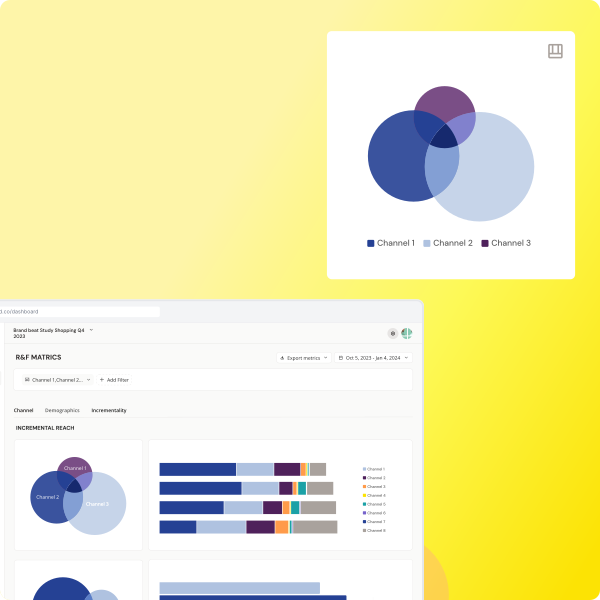
Linear says 6 million. CTV says 4 million. BVOD says 2 million. Add them up and you’ve reached more adults than exist in the market. A significant portion overlaps — you’re paying for frequency you didn’t plan and reach you didn’t get, but you can’t prove it because each source measures different people using different methods. Without person-level deduplication across every channel, your reach number is a negotiated fiction.

You walk into the planning review with a reach number you can’t fully defend. The client asks how you deduplicated across CTV and Linear. You explain the modelling. They nod. But they don’t trust it — and you know why.


venn_floating-1

The Challenge

Media platform data is often a ‘walled-garden’ view

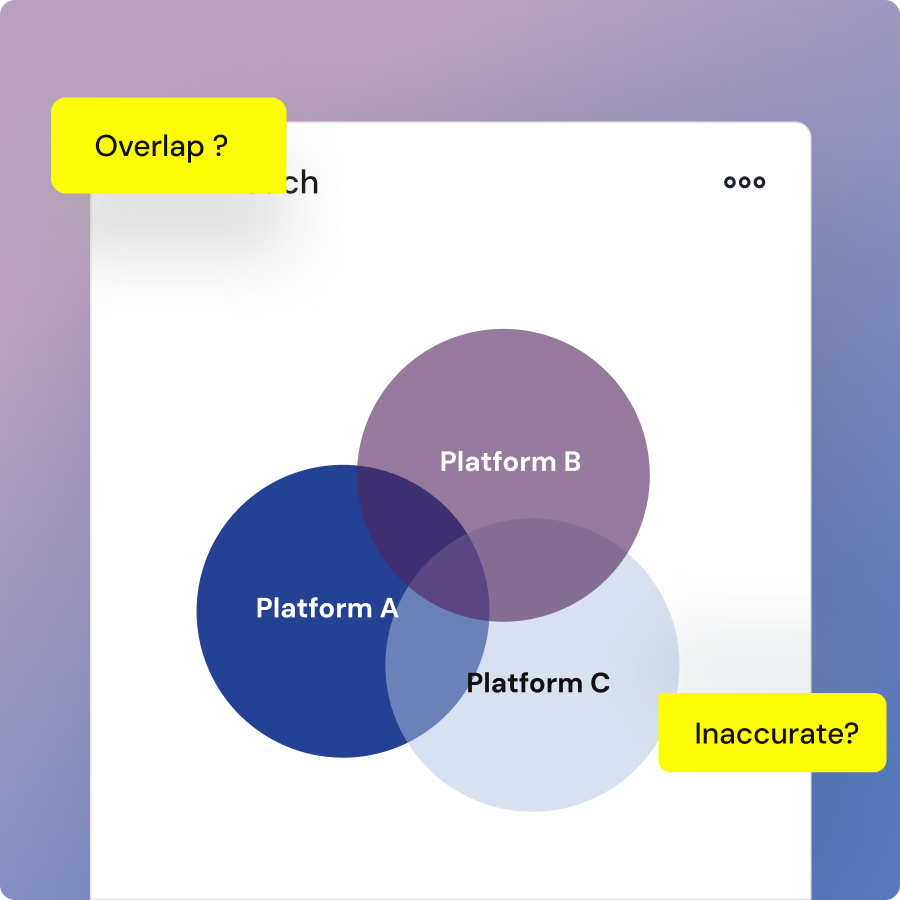
Each platform is measured in its own silo, with no shared identity to reveal who was counted more than once.

Duplicated audiences

The same viewer is counted separately on YouTube, Amazon, Netflix and TV, with no de-duplication.

Inflated reach

Counted only inside each silo, the same person adds to several platforms' totals at once, so the summed campaign reach runs well above the true unduplicated figure.

Inaccurate total frequency

With no single cross-platform view, per-person real total frequency is a guess, and you cannot cap or optimise exposure you can never see.

One platform discovered a 12% decline in reach compared to its siloed measurement

Advertisers use Reach Beat as the single-source ground truth to unveil the true incremental reach.

In one example, we measured true incremental reach across a cross-media campaign: 12% lower net reach measured from a single source compared to modelling from multiple sources.

12%-1
outcome_animation

The Solution

Deterministic, single-source cross-media measurement

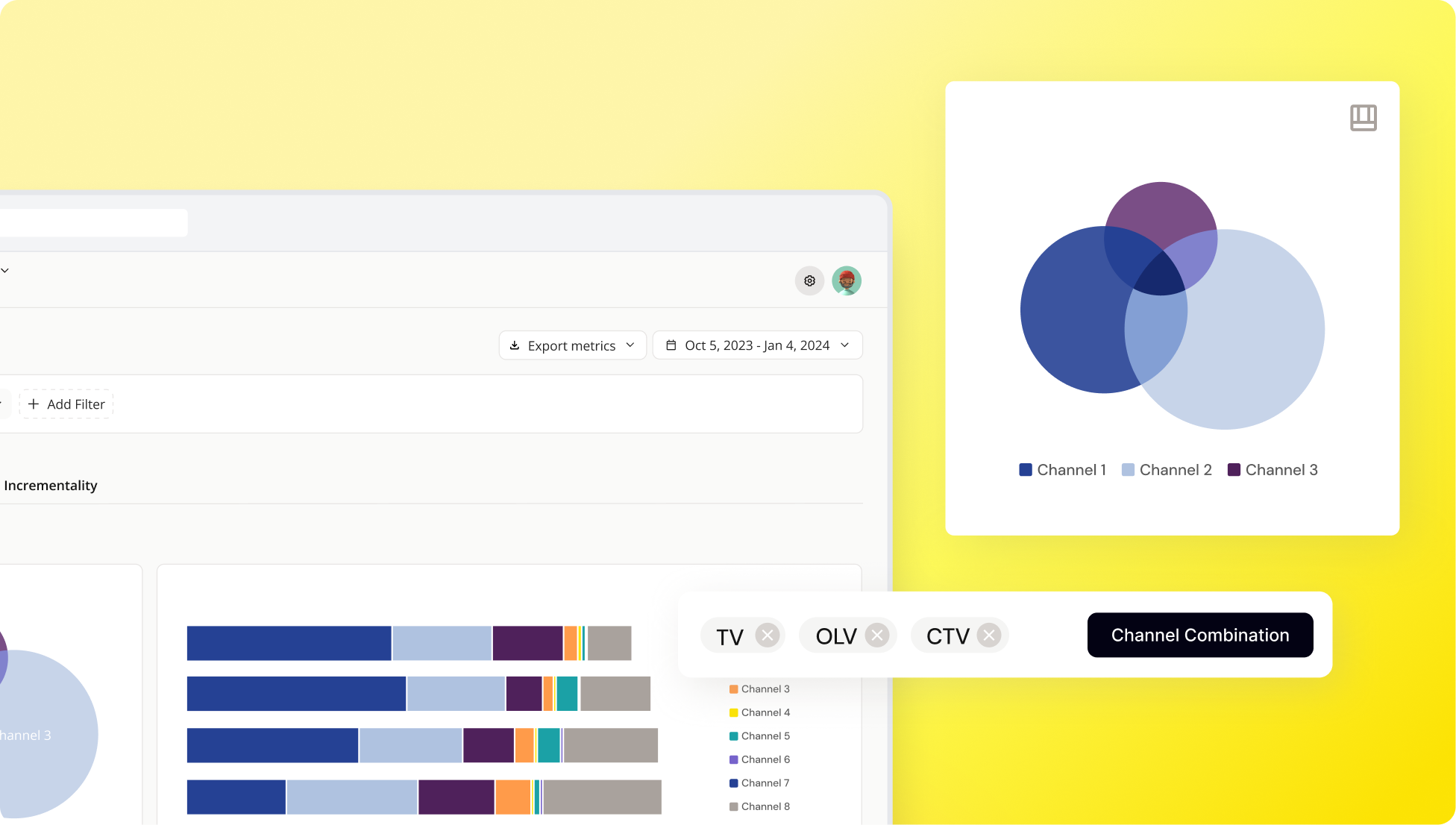
Beatgrid measures real ad exposure on each individual person across media channels. This creates a true cross-platform reach model to have the real incremental reach figure and the total net frequency figure.

The difference between Beatgrid and a traditional approach of combining multiple measurement sources, such as media platform data, can mean you are wasting millions of dollars.  

Methodology section

How ReachBeat measures true incremental reach across channels.

Cross-media reach only reconciles when every channel is measured on the same people. ReachBeat uses Beatgrid’s single-source panel to observe exposure across CTV, Linear TV, BVOD, YouTube, Audio, and OOH — passively, at person level, on the same device.

Single-source panel design

One panel of real people, measured across every channel with one methodology. Stitching bias eliminated.

Person-level exposure detection

Smartphone ACR detects exposure passively on each panellist across every screen. Modelling bias eliminated.

Cross-touchpoint deduplication

Each panellist counted once, even when exposed on multiple channels — deduplication observed at person level. Double-counting eliminated.

oneview-animated

Incremental reach you can defend starts with measured exposure — not stitched-together estimates.

Methodology section

How ReachBeat measures true incremental reach across channels.

Cross-media reach only reconciles when every channel is measured on the same people. ReachBeat uses Beatgrid’s single-source panel to observe exposure across CTV, Linear TV, BVOD, YouTube, Audio, and OOH — passively, at person level, on the same device.

Single-source panel design

One panel of real people, measured across every channel with one methodology. Stitching bias eliminated.

Person-level exposure detection

Smartphone ACR detects exposure passively on each panellist across every screen. Modelling bias eliminated.

Cross-touchpoint deduplication

Each panellist counted once, even when exposed on multiple channels — deduplication observed at person level. Double-counting eliminated.

Incremental reach you can defend starts with measured exposure — not stitched-together estimates.

oneview-animated

Methodology

Measures true incremental reach across channels

Cross-media reach only reconciles when every channel is measured on the same people. Reach Beat uses Beatgrid’s single-source panel to observe exposure across CTV, Linear TV, BVOD, YouTube, Audio, and OOH — passively, at person level, on the same device.

Incremental reach you can defend starts with measured exposure, not stitched-together estimates.

single-sourse-2
Single-source panel design

One panel of real people, measured across every channel with one methodology. Stitching bias eliminated.

Person-level
Person-level exposure detection

Smartphone ACR detects exposure passively on each panellist across every screen. Modelling bias eliminated.

deduplication
Cross-touchpoint deduplication

Each panellist counted once, even when exposed on multiple channels — deduplication observed at person level. Double-counting eliminated.

Methodology section

How ReachBeat measures true incremental reach across channels.

Cross-media reach only reconciles when every channel is measured on the same people. ReachBeat uses Beatgrid’s single-source panel to observe exposure across CTV, Linear TV, BVOD, YouTube, Audio, and OOH — passively, at person level, on the same device.
Single-source panel design

Single-source panel design

One panel of real people, measured across every channel with one methodology. Stitching bias eliminated.



Step2

Person-level exposure detection

Smartphone ACR detects exposure passively on each panellist across every screen. Modelling bias eliminated.

step3

Cross-touchpoint deduplication

Each panellist counted once, even when exposed on multiple channels — deduplication observed at person level. Double-counting eliminated.
Incremental reach you can defend starts with measured exposure — not stitched-together estimates.
image_small

How To Set Up

The 3-step plan

  • We encode your creatives and measure exposure across every channel; our team handles setup.
  • You see deduplicated reach and frequency in near real time while the campaign is running, and you can still act.
  • The data can feed into your planning tools and AI models as client-specific priors, making every future campaign more precise.

Calibrate MMM

Your next campaign starts smarter than your last one ended

 Reach Beat produces client-specific reach curves you feed directly into your tools — priors that override industry defaults. Those same priors calibrate econometric models and AI-driven planning systems with observed ground truth instead of modelled estimates. Each campaign’s measurement becomes the next campaign’s planning intelligence. 

logo-thetradedesk
logo-Netflix
logo-Google-2
logo-amazon ads

 Certified measurement partner 

What changes.

 You walk into the campaign evaluation meeting with total unduplicated reach rather than the industry defaults. Your models and AI tools calibrate against true single-source, deterministic observed data. And when the client asks how you deduplicated, you show them observed data, not a modelled deduplication. 

One view of campaign exposure

See how audiences experience your campaign across the media mix.

img reachbeat-visual
reach beat ico 1

Incremental reach

Identify which channels deliver new audiences.
reachbeat ico 2

Cross-platform frequency

Understand exposure across screens.
reachbar ico 3

Audience overlap

Reveal duplication between platforms.

Use Cases

What you can measure

Incremental

Incremental reach by channel

Understand which platforms bring new audiences.
frequency

Cross-platform frequency

Identify the optimal exposure level across screens.
Unduplicated audiences

Unduplicated audiences

Reveal duplication between channels.

Campaign-1

Campaign benchmarking

Compare performance across campaigns.

What changes for each role

step3

Media director / planning lead

You plan against deduplicated reach, not platform numbers stacked on top of each other. Incremental reach per channel shows where the next euro adds people instead of repeating them.


ci icon

Media insights / measurement lead

You stop reconciling three reach figures from three sources. One panel, one person, one method across every channel — a number that holds up when the methodology gets questioned.

channel impact ico

Analytics director

Deterministic exposure and frequency distributions feed MMM and attribution as measured inputs, not modelled assumptions. Reach curves your team can validate independently rather than accept.
CMO-1

CMO

Duplicated reach becomes visible as budget. You see how much of the spend reached new people and how much reached the same people again — instead of a channel report that quietly counts them twice.


Case study: Domino's UK

With Beatgrid, Domino's UK turned cross-channel frequency into a planning advantage—proving where brand advertising works and where spend is wasted across linear TV, CTV, YouTube and digital video. Using single-source, deterministic, person-level ACR measurement, Domino's uncovered what within-channel reports can't: a cross-channel frequency ceiling of 4× where brand metrics plateau, and just 2.4% audience overlap—validated at 0.01% variance against DV360. Presented at Google's Accelerate Measurement Event, the study gave Domino's a robust foundation to cap frequency, redirect budget to incremental reach, and prove ROI with real data, not assumptions.

Award-winning case study

winner awards-2
winner awards-3
Dominos case study

What changes

You walk into the planning meeting with client-specific reach curves instead of industry defaults. Your models and AI tools calibrate against observed data. And when the client asks how you deduplicated — you show them observed data, not a model.

Frequently asked questions

What is Reach Beat?

Reach Beat is Beatgrid's incremental reach and cross-platform frequency product. It measures real ad exposure across CTV, TV, YouTube, digital, audio, and OOH from a single panel — so you can see incremental reach by channel, true cross-platform frequency, and audience overlap between platforms.

Why is platform-reported reach inflated, and how does Reach Beat fix it?

Most platforms measure reach inside their own ecosystem, which leads to duplicated audiences, overstated campaign reach, and inaccurate frequency estimates. Reach Beat measures the same people across every platform deterministically, producing a true cross-platform reach model with no double counting.

How does Reach Beat measure incremental reach?

Because the same panel sees every channel, we can show exactly which audiences a new channel adds on top of an existing buy — for example, the unique reach CTV or YouTube delivers on top of linear TV. That makes Reach Beat the right tool for evaluating new channels and optimizing the media mix for total reach at a target frequency.

What can I measure with Reach Beat?

Incremental reach by channel, cross-platform frequency, audience overlap between platforms, and campaign benchmarking against your own previous campaigns. All four cuts come from the same dataset, so they reconcile cleanly without identity-graph stitching.

Which channels are supported?

CTV, linear TV, YouTube, digital video, online audio, and OOH — all measured against the same panel.

Can Reach Beat tell me the optimal frequency across screens?

Yes. Because we measure cumulative exposure per person across every channel, we can identify the optimal exposure level across screens — and where additional frequency on a given channel stops adding value. That feeds directly into media-mix and frequency-capping decisions.

How does Reach Beat support AI-driven media buying?

Reach Beat outputs are deterministic, person-level signals — exactly the kind of input AI-driven media planning, bidding, and optimization need. Customers use Reach Beat data to calibrate MMM, optimize cross-platform frequency strategies, and validate the channel performance signals their algorithms learn from.

How do you measure CTV incremental reach?

Our opted-in panel detects actual exposure across CTV, Linear, BVOD, YouTube, Audio, and OOH simultaneously. Because the same people are measured everywhere, we show exactly what CTV added on top of Linear — no modelling, no probabilistic matching.

Can Reach Beat data feed planning tools and AI models?

Yes. It outputs client-specific reach curves and frequency distributions that serve as priors — calibrating planning platforms, econometric models, and AI-driven planning systems with observed data.

How is this different from traditional cross-media reach?

Traditional approaches model deduplication by combining separate panels covering different channels. Reach Beat measures all channels on the same people — deduplication is observed at person level, not estimated.

How quickly do I see results?

Reach Beat delivers reach and frequency data in real time during the campaign, so you can identify frequency waste and rebalance mid-flight.