Skip to content

Cross-media brand lift, measured on verified exposure

Most brand lift measurement solutions rely on what people remember or what platforms self-report.

Beatgrid starts with what each person actually saw.  It passively detects ad exposure at the person level across CTV, Linear TV, YouTube, BVOD, social,  audio, and OOH — and measures whether it moved them.

Hero-Brand beat
brand left measurements

The Challenge

Brand lift problems today

Without verified exposure, brand measurement becomes unreliable, especially in today's fragmented media.

Recall-based surveys

Ask someone about a brand they already use, and they'll say yes— which is familiarity rather than verified exposure.

Platform reporting or OTS

In most brand lift solutions, the 'exposed group' is determined by the opportunity-to-see (OTS) questions in the survey. That is close to guessing in today's advertising

Wasted spend

Without knowing the actual frequency per channel, Brand Awareness lift is credited across every channel, even those that generated low frequency

True Single-Source Solution

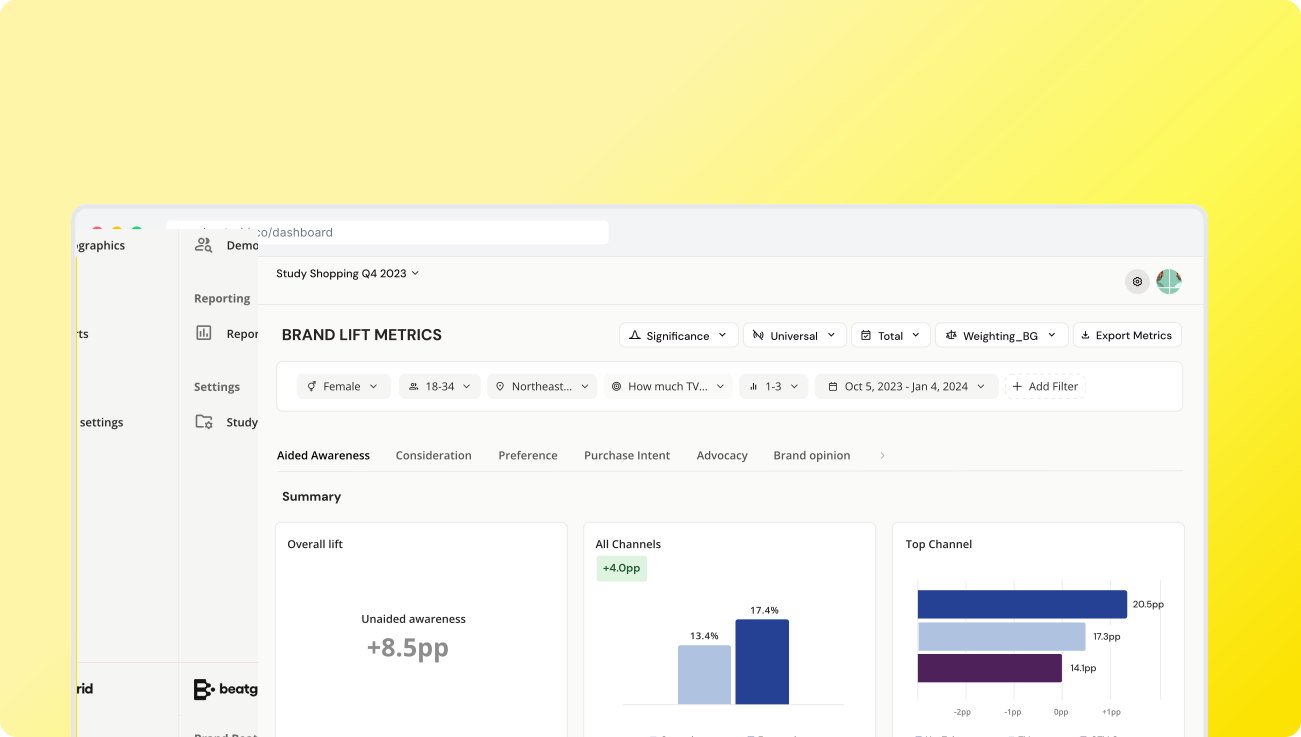
Beatgrid connects verified ad exposure to the brand survey response

brand_animation-1
awareness ico

Brand awareness

Clearly see the impact of total, cross-channel frequency.

Cp ico

Consideration

Understand shifts in each stage of the campaign influence funnel. 
ci icon

Creative impact

Identify which creatives drive the strongest response.
YouTube_chart_animated

Exposure first. Recall bias eliminated. Selection bias eliminated

Beatgrid's single-source panel already knows — at the person level, deterministically — which ads each panellist was exposed to and on which channels. Brand Beat surveys the same people: a clean exposed vs unexposed comparison with no recall bias and no platform-self-reported exposure.

You're not asking people if they remember your ad. You're measuring whether the people who definitely saw it think differently than the people who definitely didn't. Per channel. Per creative. Per audience segment.

That's the difference between a brand lift study and a brand lift proof — and it's the difference between defending channel allocation with conviction and defending it with caveats.

Methodology

How Brand Beat proves brand impact across every channel

Measuring campaign brand lift outcomes only works when you know which channels each person was exposed to and can compare them against a control group drawn from the same measurement. Brand Beat detects exposure passively on Beatgrid’s single-source panel, then surveys the same people in-flight.

Brand lift you can act on starts with measured exposure — not measured memory.

single-sourse-2
Single-source panel design

Exposed and control drawn from the same panel, measured the same way. Selection bias eliminated at the source.

Person-level
Person-level exposure detection

Smartphone ACR detects exposure passively on each panellist across every screen and channel.  Modelling bias eliminated.

Campaign weighted
Campaign-weighted comparison

A two-step weighting model reflects actual campaign reach and twins the control group to the exposed group. Structural bias removed.

Five layers of methodological rigour.

Container (4)

Passive exposure detection

One smartphone passively matches ambient audio signals to determine ad exposure across every screen — CTV, linear, YouTube, BVOD, audio, OOH. 
panel ico

Single-source panel

The same panellists are measured across all channels, so cross-channel attribution is observed rather than modelled. 

panel ico

Single-source panel

The same panellists are measured across all channels, so cross-channel attribution is observed rather than modelled. 
Container (5)

Matched control group

Exposed panellists are matched to controls on demographics and behaviour to isolate true incremental lift on the same types of audiences
Container (8)

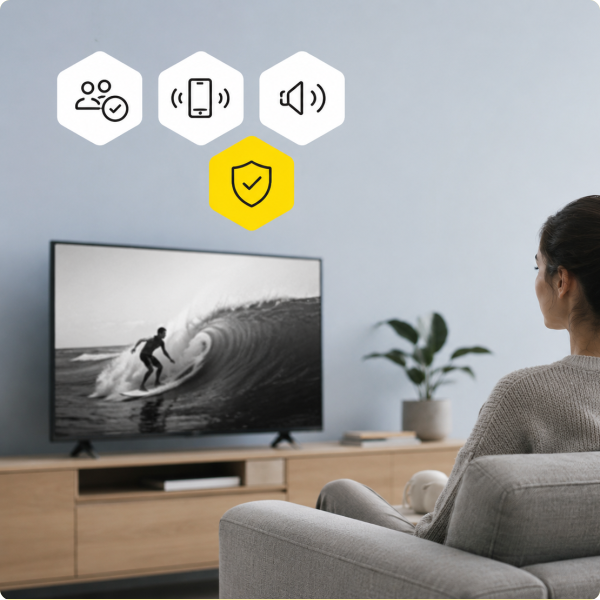
In-flight sampling

Surveys fire in post-exposure during the campaign, with a consistent exposure to the survey completion window,avoiding the recall decay that breaks post-campaign methods.

Container (8)

In-flight sampling

Surveys fire in post-exposure during the campaign, with a consistent exposure to the survey completion window,avoiding the recall decay that breaks post-campaign methods.
Statistical ico

Statistical rigour

 Lift is tested with stratified z-tests, with sample size and detectable effect reported openly per stratum. 
Frame 427320582

Identity resolution and co-viewing

Exposure is often estimated through survey questions or derived from 3-party data sources such as Smart TV data or media platform data. These are our device IDs, which could be anyone in the household, while the survey is completed by an individual. To validate that the surveyed individual was actually exposed: 

Panellist-reported viewing context confirms the panellist was present when the ad played

Device proximity and ambient detection patterns identify co-viewing situations

Survey logic confirms recency and channel of exposure before measurement questions

Known limitations are acknowledged openly and mitigated rather than ignored


This is not perfect. It is, however, more rigorous than any methodology that infers exposure from claimed media consumption or assumes household-level exposure equals individual-level exposure. 

Use Cases

What you can measure

Unaided-1

Unaided awareness

Whether people recall your brand without being prompted by name.
Aided-2

Aided awareness

Whether they recognise your brand once it's put in front of them.
Bramd consideration

Brand consideration

Whether you've moved into the set of brands they'd actually consider buying. 

Purchase intent

Purchase intent

Whether exposure shifted how likely they are to buy.

Message

Message association

Whether your campaign's core message is sticking to the brand.
Check-2

Brand attribute attribution

Which specific qualities people now connect to your brand.
Creative

Creative performance by channel

Which executions drove lift, and where they did it.

cost

Cost per lifted user

The per-channel efficiency metric your team can act on in the next planning round.

Brand Beat attributes each shift to the specific channels and creative executions that drove it. Custom survey design aligns with your existing brand tracker — same question order, same scales, same benchmarks. Your Brand Beat data talks to your brand tracker, not against it.

The same lift results also generate Bayesian priors that calibrate brand-effect models, full-funnel attribution, and AI-driven planning systems with observed ground truth instead of modelled estimates.

What changes for each role

step3

Brand insights director / advertising research lead

You stop defending recall-based numbers in front of analytics teams who already know the methodology is fragile. Exposed vs observed-control gives you results you can defend on technical grounds.


ci icon

Media director / planning lead

You see cost per lifted user by channel. Channels that did not measurably shift perception become identifiable, not assumed-effective. The next planning round starts with that evidence.

channel impact ico

Analytics director

Beatgrid data integrates as deterministic priors into MMM, full-funnel attribution, and AI-driven planning. The exposure data and rich covariates support PSS or comparable bias-control frameworks your team applies independently. 
CMO-1

CMO

Budget allocated to channels that don't move perception becomes visible and rebalanceable, instead of buried in a directional report. With confidence, your brand investment vs performance campaign investment finally becomes accurately defensible. 

Brand Lift Analysis-1

The 3-step plan

  • We encode your creatives and align the survey with your existing brand tracker. Same questions, scales, benchmarks. Our team handles setup.
  • Our panel measures real exposure across every channel passively. We survey the same people in-flight — exposed vs matched control, zero recall bias, balanced daily.
  • You get channel-level brand lift attribution with cost per lifted user, statistical significance per stratum, and Bayesian priors your models and AI tools can trust.

Sanofi delivered the highest brand lift in its category. BrandBeat proved it.

Sanofi ran a BVOD campaign via The Trade Desk and used BrandBeat to measure brand lift. The result: 37% incremental BVOD reach and the highest brand lift score recorded in the pharmaceutical category for that period — proof that observed-exposure measurement detects effects that recall-based studies miss. 

image-Single-Source Profiles (4)

Case study: Google Marketing UK

With Beatgrid, Google turned passive measurement into a competitive edge—tracking respondent-level exposure across every AV and outdoor channel with MRS-compliant ACR and geo-location technology. The result: the award-winning Google SuperPanel, a single-source panel of 7,500+ respondents that links real survey responses to verified media exposure. Cross-channel brand measurement moved from estimates to a proven gold standard, backed by passive and survey data, not assumptions.

Award-winning case study

winner awards-2
winner awards-3
Google case study-2

What changes

Your brand investment becomes defensible at the level it matters — to your analytics team, to your media planning lead, to your client, and ultimately to the board. Per-channel cost per lifted user means the next planning conversation starts with evidence, not hypothesis. Your models and AI planning tools calibrate on real lift. And your brand tracker finally has a cross-media partner that speaks the same language.

Frequently asked questions

What is Brand Beat?

Brand Beat is Beatgrid's cross-media brand lift measurement product. It connects passively verified ad exposure to brand outcomes — measured at person level across CTV, Linear TV, BVOD, YouTube, audio, OOH, and social, on a single-source panel.

How is Brand Beat different from traditional brand lift measurement?

Traditional brand lift relies on recall surveys — asking people what ads they remember seeing. Brand Beat starts with deterministic, passive exposure detection via smartphone ACR, then surveys the same people exposed vs matched control. No recall bias, no platform-self-reported exposure, no probabilistic modelling.

How is Brand Beat different from platform-provided brand lift studies?

Platform studies survey people the platform believes it reached, introducing selection bias — the platform is grading its own homework. Brand Beat uses independent, observed exposure detection. The exposed group is verified, not platform-self-reported.

How do you match exposed and control groups?

Control panellists are drawn from the same panel as exposed panellists and matched on demographic and behavioural covariates: age, gender, region, household income, education, media consumption, channel usage, category usage, brand familiarity, and prior purchase behaviour. Matching produces balanced comparison groups suitable for stratified analysis including Propensity Score Stratification (PSS) and comparable frameworks. 

What channels does Brand Beat cover?

CTV, Linear TV, BVOD, SVOD, YouTube CTV, YouTube BAU, social (TikTok, Meta), audio (linear and digital), podcasts, and OOH. All measured on the same people through one panel, simultaneously. 

Does Brand Beat support Propensity Score Stratification (PSS)?

Brand Beat provides the deterministic exposure data and rich panellist covariates that PSS and other modern bias-control frameworks operate on. Analytics teams running their own PSS pipelines can apply the methodology directly to Beatgrid data. We can also work with your statistical team to integrate PSS-specific reporting — Standardised Mean Difference (SMD) tables, Effective Sample Size (ESS) per stratum, common support definitions. 

How does in-flight sampling work?

As panellists are passively detected as exposed during the campaign, survey invitations dispatch in real time. Control group recruitment happens in parallel, balanced daily against the exposed group's demographic and behavioural profile. Channel-specific recruitment mirrors media weight distribution. This avoids recall decay and minimises exclusion periods. 

How does Brand Beat handle household-to-individual identity resolution?

Exposure is captured at the smartphone device level. Co-viewing logic uses panellist-reported viewing context and device proximity data to validate that the surveyed individual was present when the ad played. Known limitations — iOS audio capture with headphones, device-level vs individual-level tracking — are acknowledged and mitigated rather than ignored. 

What is the Minimum Detectable Effect (MDE)?

MDE depends on campaign scale, audience, and market coverage. For sufficiently powered studies, we target MDEs as low as 2%. We report Effective Sample Size (ESS) alongside raw sample size per stratum so the statistical penalty of weighting is transparent. 

What is cost per lifted user?

Media spend divided by the number of people whose brand perception measurably changed. It's a per-channel efficiency metric — not just a percentage lift — that planning teams can act on directly in the next round. 

Can Brand Beat align with our existing brand tracker?

Yes. We match question order, scales, and benchmarks so Brand Beat integrates with your longitudinal tracking rather than creating a parallel dataset. Your tracker stays the system of record; Brand Beat extends it cross-media. 

Can Brand Beat data feed our econometric models and AI planning systems?

Yes. Lift results generate Bayesian priors compatible with MMM platforms (including Meridian and Robyn), full-funnel attribution, and AI-driven planning systems. The deterministic priors replace modelled estimates with observed ground truth. 

How does Beatgrid prevent panel fraud?

Beatgrid's panel uses passive smartphone ACR — not survey-based recruitment alone — which raises the barrier for bot and AI-agent fraud significantly. Behavioural patterns, device-level signals (no PII), and exposure pattern analysis detect and remove fraudulent activity. The panel is opt-in through Beatgrid's own consumer apps (Media Rewards, Jagger), adding another layer of authentication. 

How quickly do I see results?

Reach and frequency are visible in real time during the campaign. Brand lift outputs are delivered after the survey field closes — typically 1-2 weeks after campaign end. 

Is Brand Beat MRC accredited?

Beatgrid's methodology is MRC and ESOMAR compliant and has been reviewed by GfK, Dynata, GroupM, and Omnicom. Specific accreditation status can be discussed during a methodology briefing. 

Which markets does Brand Beat operate in?

Six markets: United States, United Kingdom, Australia, Germany, Canada, India. Each market panel is demographically weighted and uses the same measurement methodology.